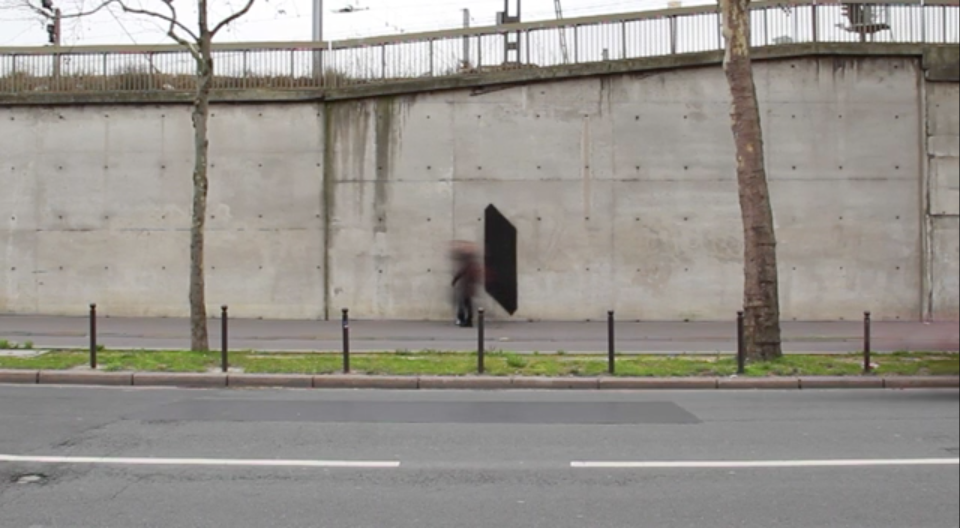
Réalisée en 2011 pour Arte Creative, Monolith n°4 est une vidéo sonore de quatre minutes conçue dans le contexte immédiat de la catastrophe de Fukushima. Son titre renvoie au réacteur n°4 de la centrale de Fukushima Daiichi, devenu dans les jours suivant le séisme et le tsunami du 11 mars 2011 l’un des foyers d’inquiétude et d’incertitude entourant l’accident nucléaire.
La vidéo repose sur un plan presque fixe : sur un mur de béton gris apparaît la silhouette noire et isométrique d’un monolithe. Des véhicules traversent ponctuellement le premier plan, tandis que la bande sonore mêle bruits de circulation et fragments d’informations techniques liés à la catastrophe. Les voix sont présentes mais partiellement brouillées, comme si l’information parvenait depuis un espace devenu inaccessible.
Le monolithe ne représente ni le réacteur ni la catastrophe. Il agit davantage comme un signe d’opacité. Forme minimale, noire, silencieuse, il condense quelque chose qui résiste à l’image et à l’explication. Face à un événement saturé de données, de mesures, d’alertes et d’informations contradictoires, la géométrie demeure muette.
Le numéro « 4 » crée alors un déplacement entre nomenclature technique et imaginaire de science-fiction. Le réacteur devient numéro, comme le monolithe devient indice. L’événement réel et la forme abstraite se rencontrent sans jamais se confondre.
Monolith n°4 travaille ainsi moins sur la représentation d’une catastrophe que sur l’impossibilité de la saisir au moment où elle advient. Entre image fixe et circulation, information et brouillage, présence et menace invisible, la vidéo construit un paysage suspendu dans lequel le monolithe apparaît comme la trace opaque d’un événement encore en cours.
2011, vidéo sonore 4′, Paris.
Vidéo diffusée sur Artecreative.
http://creative.arte.tv
Created in 2011 for Arte Creative, Monolith No. 4 is a four-minute video with sound conceived in the immediate context of the Fukushima disaster. Its title refers to Reactor No. 4 at the Fukushima Daiichi nuclear power plant, which became one of the focal points of uncertainty and concern in the days following the earthquake and tsunami of March 11, 2011.
The video is built around an almost static shot: the black, isometric silhouette of a monolith appears against a grey concrete wall. Vehicles occasionally cross the foreground, while the soundtrack combines traffic noise with fragments of technical information related to the disaster. Voices are present but partially obscured, as if the information were arriving from a space that had become inaccessible.
The monolith represents neither the reactor nor the disaster itself. It functions instead as a sign of opacity. Minimal, black, and silent, it condenses something that resists both image and explanation. Faced with an event saturated with data, measurements, warnings, and contradictory information, the geometry remains mute.
The number “4” creates a shift between technical nomenclature and science-fiction imagery. The reactor becomes a number, just as the monolith becomes an index. The real event and the abstract form meet without ever merging.
Monolith No. 4 is therefore less concerned with representing a catastrophe than with the impossibility of grasping it as it unfolds. Between stillness and circulation, information and interference, presence and invisible threat, the video constructs a suspended landscape in which the monolith appears as the opaque trace of an event still in progress.