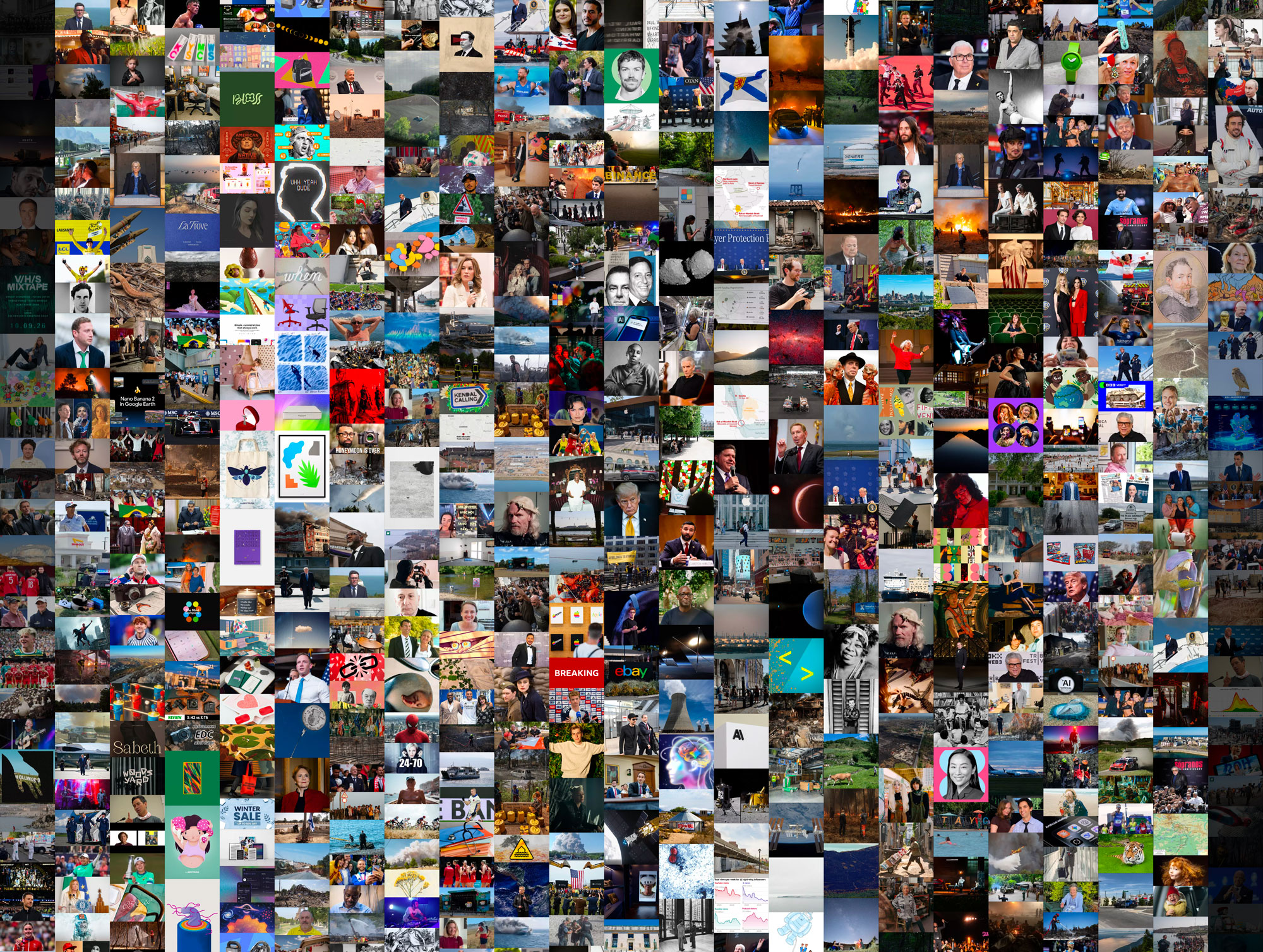
2026, site web, installation, photographie (réactivation de GridFlow 2011)
https://www.reynalddrouhin.net/works/gridflow-reload/
GridFlow Reload agrège en continu des flux RSS et Atom provenant du Web. Chaque nouvelle publication apporte une image qui rejoint un ruban de colonnes. Elle apparaît en haut à gauche, pousse les précédentes vers le bas, puis se poursuit dans la colonne suivante. Le ruban forme ainsi une ligne de temps repliée sur elle-même, depuis l’instant présent jusqu’aux images qui achèvent leur passage.
Les colonnes ne composent pas une mosaïque d’éléments séparés. Lorsqu’une image dépasse la hauteur de l’écran, elle est interrompue puis reprend au sommet de la colonne suivante. Le regard parcourt une bande continue, une tranche de temps prélevée dans un mouvement qui la déborde.
Aucune composition n’est déterminée à l’avance. Les rapprochements entre les images naissent de la simultanéité des publications. Chacun peut enrichir le projet en indiquant l’adresse d’un site dont le flux est automatiquement recherché. GridFlow Reload compose ainsi une image collective et provisoire du présent, un Zeitgeist produit par la circulation des images.
Dans la version originale, les images s’accumulaient continuellement sur le serveur. Cette accumulation est progressivement devenue l’une des limites du projet. GridFlow Reload en déplace le principe : les fichiers d’origine ne sont pas conservés et les vignettes ne restent que le temps de traverser le ruban. Elles apparaissent, circulent, puis disparaissent pour laisser place aux suivantes.
Le projet ne construit plus une archive permanente, mais une mémoire de passage. La disparition n’est pas une défaillance. Elle permet au flux de se renouveler et fait de l’oubli une condition de son fonctionnement.
Le ruban ne progresse qu’à la visite. Chaque consultation actualise les flux et participe au mouvement du projet. Le visiteur peut suspendre le défilement, modifier la densité des vignettes, capturer une configuration et ouvrir chaque image dans son contexte de publication.
Quinze ans après la création de GridFlow, cette réactivation rend perceptible un présent en transformation continue. Dans GridFlow Reload, les images ne sont plus destinées à être conservées. Elles sont destinées à passer.
GridFlow Reload continuously aggregates RSS and Atom feeds from across the Web. Each new publication contributes an image to a ribbon of columns. It appears in the upper-left corner, pushes the previous images downward and then continues into the next column. The ribbon forms a timeline folded onto itself, from the present moment to the images completing their passage.
The columns do not form a mosaic of separate elements. When an image exceeds the height of the screen, it is interrupted and resumes at the top of the following column. The viewer encounters a continuous band, a slice of time extracted from a movement that extends beyond the visible frame.
Nothing is composed in advance. Relationships between images emerge from the simultaneity of publications. Anyone can enrich the project by entering the address of a website, whose feed is then automatically discovered. GridFlow Reload composes a collective and temporary image of the present, a Zeitgeist produced through the circulation of images.
In the original version, images accumulated continuously on the server. Over time, this accumulation became one of the project’s limitations. GridFlow Reload shifts this principle: original files are not retained, and thumbnails remain only for the duration of their passage through the ribbon. They appear, circulate and disappear to make room for those that follow.
The project no longer constructs a permanent archive, but a memory of passage. Disappearance is not a failure. It allows the flow to renew itself and makes forgetting a condition of its operation.
The ribbon advances only when someone visits. Each consultation updates the feeds and contributes to the movement of the project. Visitors can pause the scrolling, change the density of the thumbnails, capture a configuration and open each image within its original publishing context.
Fifteen years after the creation of GridFlow, this reactivation makes a continuously transforming present perceptible. In GridFlow Reload, images are no longer meant to be preserved. They are meant to pass.