J’eux

2001, site Internet.
http://www.reynalddrouhin.net/works/j-eux/

2001, photographie, affiche dimension variable.
j-eux

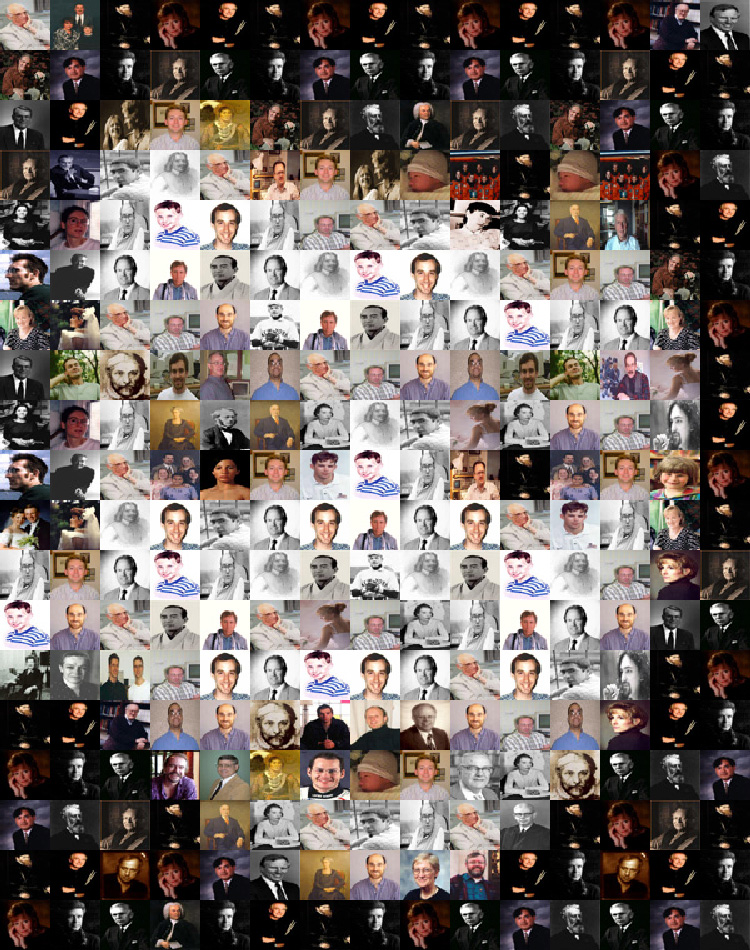
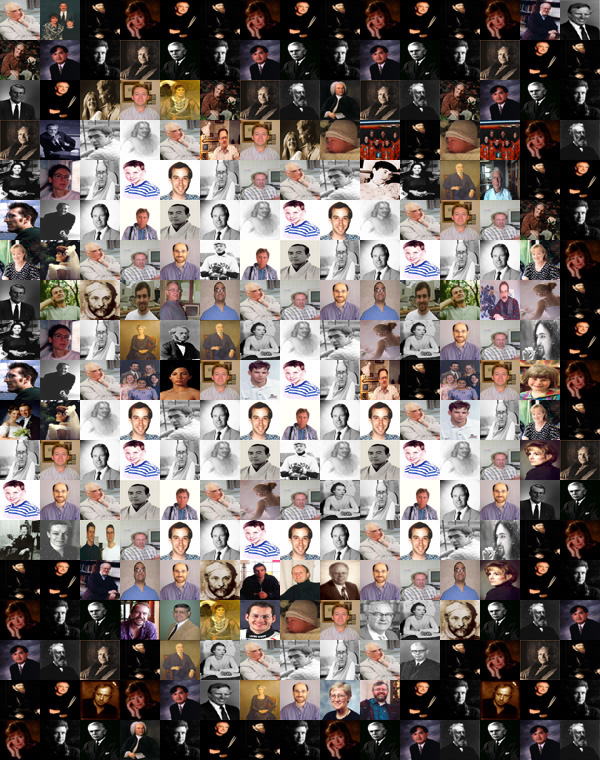
Réalisé en 2001, J’eux est un projet Internet et photographique construit à partir du principe développé dans Des Frags. Une base de données constituée d’images trouvées sur le Web à partir du mot-clé « portrait » est utilisée pour recomposer le visage d’un enfant. Des fragments provenant de personnes anonymes deviennent ainsi les éléments d’une nouvelle image.

Le titre condense le principe du projet : « je » et « eux » se confondent. Le portrait individuel n’est plus conçu comme l’expression d’une identité autonome, mais comme une construction produite à partir d’une multitude d’autres visages. L’un apparaît à travers les autres.

Internet devient ici à la fois archive, mémoire et matière première. Les moteurs de recherche ne servent pas simplement à retrouver des images : ils alimentent un processus de recomposition dans lequel des photographies dispersées sur le réseau sont extraites de leur contexte initial, fragmentées puis réassemblées.

À distance, la mosaïque restitue le portrait de l’enfant. En s’approchant, cette unité se dissout et laisse apparaître la diversité des images qui la constituent. Le regard oscille ainsi entre une identité reconnaissable et la multitude anonyme sur laquelle elle repose.

J’eux interroge de cette manière la construction de l’identité à l’ère du réseau. Le portrait n’est plus seulement une image de soi : il devient une surface collective, instable, composée de fragments appartenant aux autres. Le « je » n’efface pas les « eux » qui le constituent ; il apparaît précisément à travers eux.


Created in 2001, J’eux is an Internet-based and photographic project developed from the principle established in Des Frags. A database of images found on the Web using the keyword “portrait” is used to reconstruct the face of a child. Fragments taken from anonymous individuals thus become the components of a new image.

The title itself condenses the principle of the work through a French wordplay. J’eux combines je (“I”) and eux (“them”), while sounding exactly like jeux (“games”). The title therefore brings together the self, the others, and the idea of play within a single word. The individual portrait is no longer conceived as the expression of an autonomous identity, but as a construction produced from a multitude of other faces. The “I” emerges through “them,” while the image itself becomes a game of fragmentation, substitution, and recomposition.

Here, the Internet becomes archive, memory, and raw material at once. Search engines are not used simply to retrieve images: they feed a process of recomposition in which photographs scattered across the network are removed from their original context, fragmented, and reassembled.

From a distance, the mosaic reconstructs the portrait of the child. Up close, this unity dissolves and reveals the diversity of the images from which it is composed. The viewer thus moves between a recognizable identity and the anonymous multitude on which it depends.

J’eux questions the construction of identity in the networked age. The portrait is no longer simply an image of the self: it becomes a collective and unstable surface composed of fragments belonging to others. The “I” does not erase the “them” that constitute it; it appears precisely through them.